Battery Electrolyte Chemistry Market Projected to Reach USD 44.5 Billion by 2035
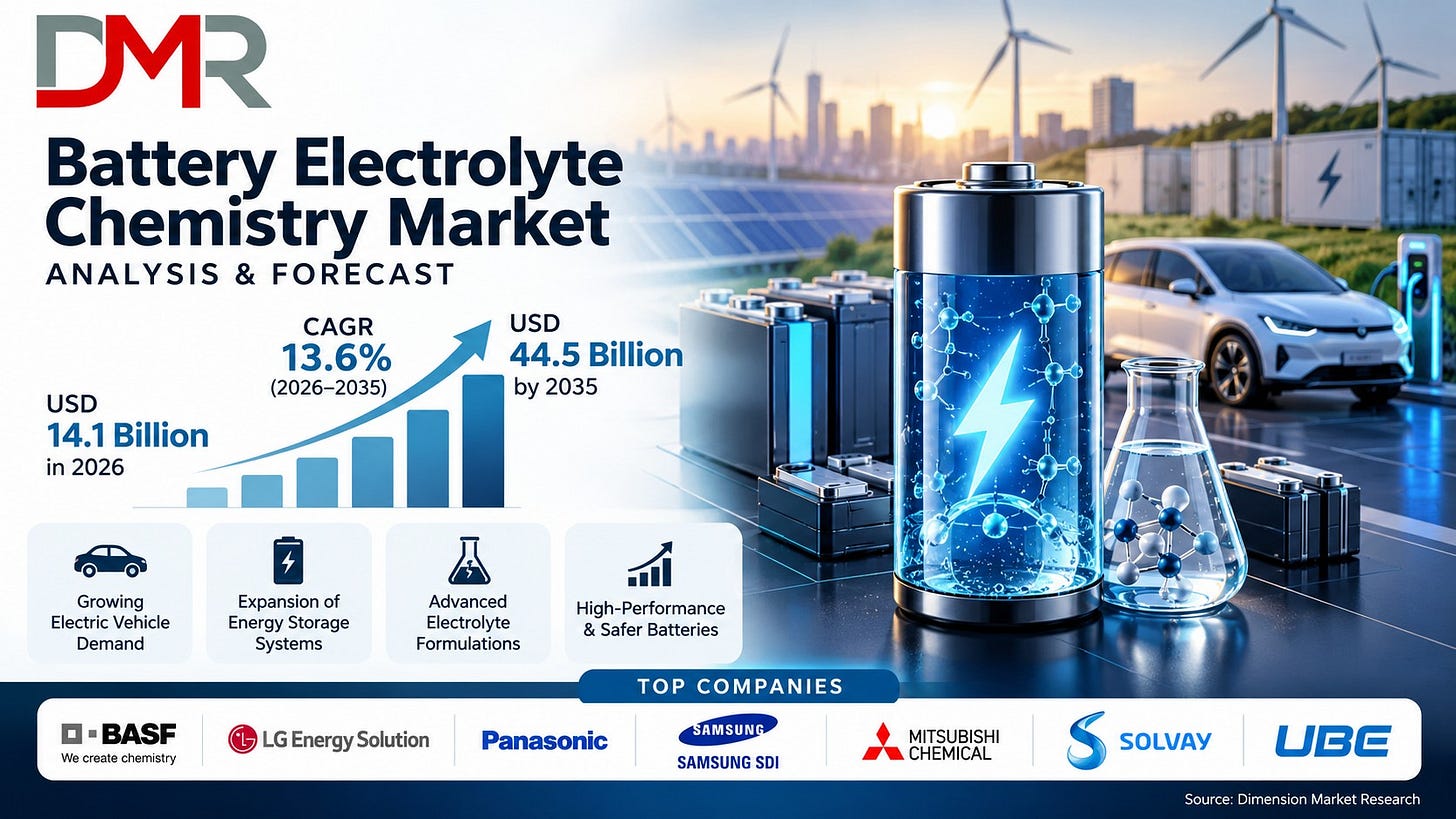
Battery Electrolyte Chemistry Market Forecast to Reach USD 44.5 Billion by 2035
The global Battery Electrolyte Chemistry Market is estimated to reach USD 14.1 billion in 2026 and is projected to increase to USD 44.5 billion by 2035, registering a compound annual growth rate (CAGR) of 13.6%, according to Dimension Market Research. This growth outlook reflects rising demand for electric vehicles, advanced lithium-ion batteries, grid-scale energy storage and electrolyte formulations designed to improve battery performance and safety.
Battery electrolytes enable ion movement between electrodes and influence conductivity, charging behavior, temperature stability and battery life. As battery manufacturers pursue higher energy density, faster charging and improved reliability, the demand for specialized lithium salts, solvents and additives is increasing. Investment in solid-state battery research, high-voltage electrolyte formulations and automated manufacturing processes is also creating opportunities for suppliers across the global battery materials industry. These developments are placing electrolyte chemistry at the center of next-generation battery innovation.
Get free sample of this report (with custom data option): https://dimensionmarketresearch.com/request-sample/battery-electrolyte-chemistry-market/
Battery Electrolyte Chemistry Market Snapshot
- 2026 global market valuation: USD 14.1 billion.
- 2035 projected market valuation: USD 44.5 billion.
- 2026 to 2035 forecast CAGR: 13.6%.
- Liquid electrolytes: 64.2% projected share in 2026.
- Lithium-ion batteries: 55.3% projected share in 2026.
- Electric vehicles: 68.8% projected application share in 2026.
- Lithium salts: 45.6% projected chemistry share in 2026.
- Asia-Pacific: 43.6% projected regional share in 2026.
Market Research Findings
Dimension Market Research identifies substantial opportunities across electrolyte materials, battery technologies and end-use applications. Liquid electrolytes are expected to retain the largest segment share because of their established role in commercial lithium-ion batteries. Lithium-ion technology remains central to EV manufacturing, consumer electronics and stationary storage. The report also highlights opportunities in solid-state electrolytes, sodium-ion batteries and specialized additives. Market performance will depend on manufacturing capacity, material availability, formulation compatibility, product quality and investment in battery research. Its segmentation covers electrolyte type, battery type, chemistry, application and end user, providing a framework for evaluating market positioning and opportunities through 2035.
Why Is the Battery Electrolyte Chemistry Market Growing?
Increasing electric vehicle adoption and expanding energy storage installations are creating demand for reliable, high-performance batteries. Electrolyte formulations affect a cell's ability to deliver consistent power, operate across different temperatures and maintain stability during repeated charging cycles. Manufacturers are therefore investing in materials that support high-voltage cathodes, fast charging and longer battery life.
Battery safety is another important consideration. Better electrolyte stability, improved additive chemistry and stringent quality testing can help manufacturers address degradation and thermal risks. At the same time, the expansion of battery gigafactories is encouraging suppliers to scale production, strengthen supply chains and develop formulations for specific battery designs.
Key Growth Drivers of the Battery Electrolyte Chemistry Market
- EV manufacturing expansion increases demand for battery electrolyte materials.
- Grid-scale energy storage supports demand for reliable battery systems.
- High-energy-density targets encourage advanced electrolyte formulation research.
- Battery safety priorities increase interest in stable electrolyte chemistries.
- Gigafactory investments create opportunities for large-volume electrolyte suppliers.
- Solid-state battery research encourages development of alternative electrolytes.
Research Scope and Leading Market Segments
Liquid Electrolytes
Liquid electrolytes are projected to account for 64.2% of the global market in 2026. Their established manufacturing processes, strong ionic conductivity and broad application across commercial lithium-ion batteries support their leading position. LiPF6-based electrolytes remain important in conventional battery systems, while LiFSI-based formulations and specialized additives are being explored for demanding operating conditions. Manufacturers continue to focus on improving electrochemical stability, managing moisture sensitivity and supporting compatibility with evolving electrode materials.
- High-voltage electrolyte formulations for advanced battery cells.
- Additives designed to improve electrode interfaces and cycle life.
- Quality control for consistent large-scale electrolyte production.
Lithium-Ion Batteries
Lithium-ion batteries are expected to hold 55.3% of the market in 2026. Their extensive use in electric vehicles, electronics and stationary energy storage creates a strong foundation for electrolyte demand. Performance requirements differ by application, making solvent selection, lithium salt concentration and additive chemistry important factors in battery design. Meanwhile, solid-state and sodium-ion technologies offer potential opportunities for suppliers developing specialized electrolyte materials.
- EV demand supports high-volume lithium-ion battery production.
- Fast-charging applications require improved electrolyte performance.
- Energy storage projects increase demand for dependable battery operation.
Read more about this market:https://dimensionmarketresearch.com/report/battery-electrolyte-chemistry-market/
Battery Electrolyte Chemistry Market Dynamics
Market Trends
Electrolyte manufacturers are developing formulations for high-voltage cathodes, fast-charging systems and emerging battery architectures. Research into fluorinated solvents, functional additives and alternative lithium salts aims to improve stability and manage unwanted reactions at electrode interfaces. Solid-state electrolytes are also attracting attention because of their potential to support different safety and energy-density requirements. Automated testing and analytical methods can help accelerate formulation screening and improve production consistency.
Market Opportunities
Growing EV production, renewable energy integration and battery manufacturing investments create opportunities for electrolyte suppliers. Localized production near battery factories can strengthen supply reliability and reduce logistics challenges. Additional opportunities include specialized additives, application-specific formulations and materials designed for next-generation batteries. Collaboration between electrolyte producers, battery manufacturers and research institutions can help move promising formulations from laboratory development to commercial production.
Market Challenges
Raw material price volatility, manufacturing complexity and formulation compatibility remain important challenges. Some electrolyte ingredients require strict moisture control and specialized handling. New formulations must undergo extensive testing to demonstrate performance, stability and compatibility with battery components. Scaling production while maintaining consistent quality can increase costs, particularly for smaller manufacturers. Emerging technologies also face technical and commercialization barriers that may affect adoption timelines.
Regional and Country Outlook
Asia-Pacific is expected to lead the global Battery Electrolyte Chemistry Market in 2026 with a 43.6% share, supported by battery manufacturing capacity, EV demand and established electrolyte supply chains. North America is identified as the fastest-growing region in the supplied report, driven by investment in domestic battery production and advanced battery research.
- United States: USD 1.5 billion in 2026, with a CAGR of 12.8%.
- Europe: USD 2.2 billion in 2026, with a CAGR of 13.4%.
- Japan: USD 820 million in 2026, with a CAGR of 11.9%.
The report identifies regional differences in manufacturing investment, research priorities and battery supply chain development. Numerical market values and CAGRs are included above only where supplied in the source material.
Key Competitors in the Battery Electrolyte Chemistry Market
- Guangzhou Tinci Materials Technology Co., Ltd.
- Shenzhen Capchem Technology Co., Ltd.
- Enchem Co., Ltd.
- Mitsubishi Chemical Group Corporation
- Zhangjiagang Guotai Huarong New Chemical Materials Co., Ltd.
- UBE Corporation
- LG Chem Ltd.
- BASF SE
- Soulbrain Co., Ltd.
- Dongwha Electrolyte Co., Ltd.
- Mitsui Chemicals, Inc.
- Central Glass Co., Ltd.
- Shanshan Technology Co., Ltd.
- Panax-Etec Co., Ltd.
- Stella Chemifa Corporation
- Morita Chemical Industries Co., Ltd.
- Shida Shenghua Chemical Group Co., Ltd.
- Zhejiang Yongtai Technology Co., Ltd.
- Solvay S.A.
- Targray Industries Inc.
Get 10% instant discount on report purchase
Explore more reports:
- Memory Semiconductor Market
- Marine Battery Market
- Marine Adhesive Market
- Manufacturing Operations Management Platforms Market
FAQ's
1. What is the Battery Electrolyte Chemistry Market size in 2026?
The global market is estimated at USD 14.1 billion in 2026, according to Dimension Market Research.
2. What will the market be worth by 2035?
The market is projected to reach USD 44.5 billion by 2035, with demand supported by battery manufacturing and advanced applications.
3. What is the expected market CAGR?
The market is expected to register a 13.6% CAGR over the 2026 to 2035 forecast period.
4. Which electrolyte type leads the market?
Liquid electrolytes are projected to lead in 2026, accounting for approximately 64.2% of global market share.
5. Which battery type has the largest share?
Lithium-ion batteries are projected to account for 55.3% of the market in 2026.
6. Which application leads the market?
Electric vehicles are projected to represent 68.8% of market share in 2026, according to the supplied report.
7. Which region dominates the market?
Asia-Pacific is projected to lead in 2026 with a 43.6% share of the global market.
8. What are the main market growth drivers?
EV adoption, energy storage deployment, battery factory expansion and demand for improved performance support market growth.
9. Who are the major market competitors?
Key participants include Tinci Materials, Capchem, Enchem, Mitsubishi Chemical Group, UBE, LG Chem, BASF and Soulbrain.
10. What opportunities will shape the market through 2035?
Advanced additives, high-voltage electrolytes, solid-state battery development and localized manufacturing present significant opportunities.
About Us
Dimension Market Research (DMR) is a global market intelligence and consulting firm delivering data-driven insights that help organizations make informed strategic decisions. With expertise across 12+ industries and global markets, DMR provides syndicated reports, custom research, competitive analysis, white space analysis, and business strategy consulting.
Our research solutions combine analytical rigor, industry expertise, and forward-looking intelligence to identify opportunities, reduce risks, and support sustainable growth. Trusted by clients across diverse sectors, DMR is committed to delivering accurate, actionable insights that enable businesses to navigate evolving market landscapes with confidence.
Contact Us
Phone USA: +17323699777
Phone India: +919310023843
E-mail: enquiry@dimensionmarketresearch.com
Address USA: 957 Route 33, Suite 12 #308, Hamilton Square, NJ-08690
Address India: D44, Sector 6, Noida 201301, India